
COMPULSORY EARTHQUAKE INSURANCE (DASK)
Understanding the Turkish Compulsory Earthquake Insurance Policy (DASK)
Every residential property in Turkey must have Compulsory Earthquake Insurance (DASK). Below you can see how a typical policy looks in Turkish, together with English explanations of the main fields and a summary of what is covered.
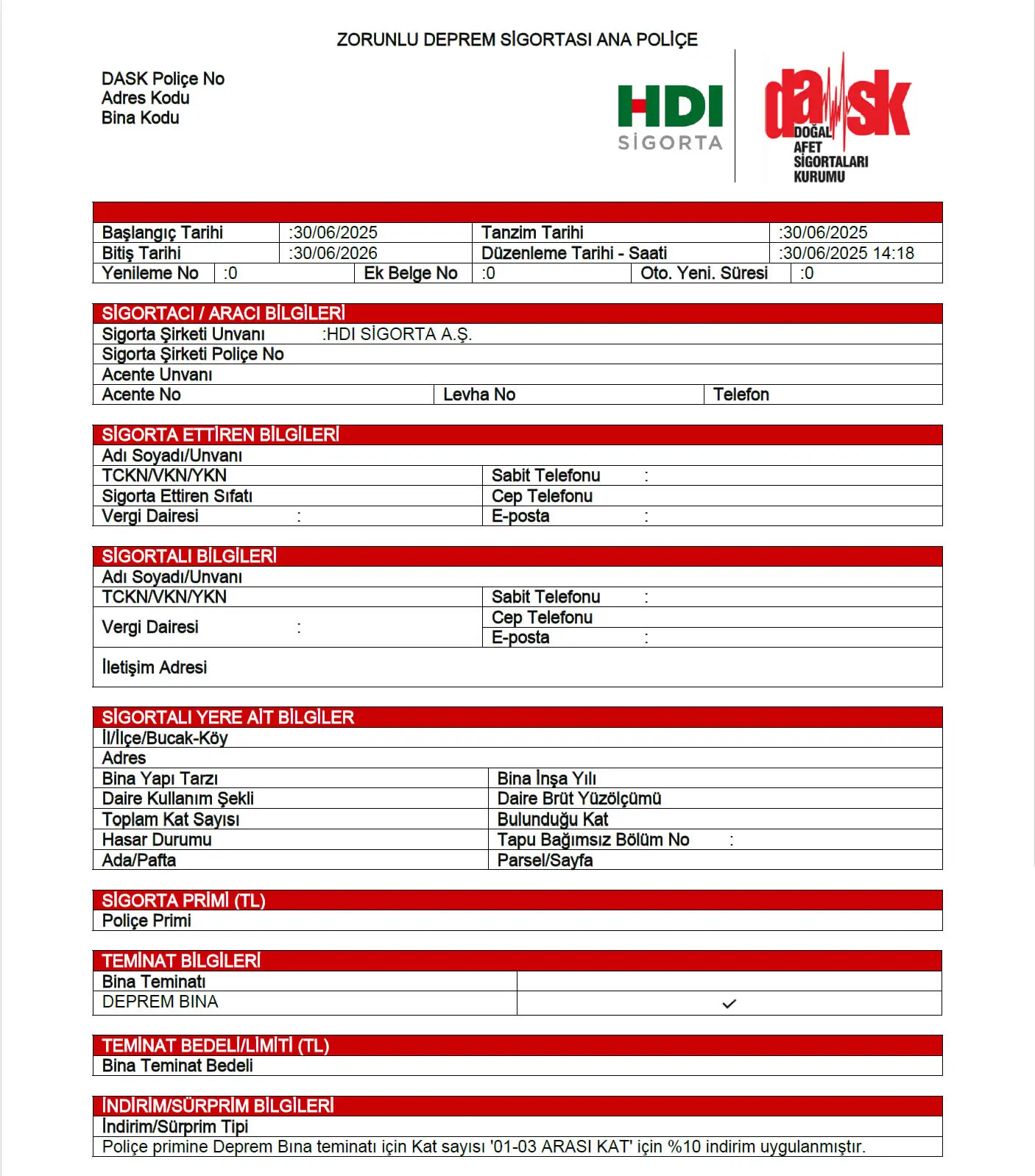
Key fields on a DASK policy
The policy document is in Turkish. The table below shows the most important headings on the sample and their English equivalents so you can read your own DASK policy with confidence.
| Turkish field | English meaning |
|---|---|
| Zorunlu Deprem Sigortası Ana Poliçe | Compulsory Earthquake Insurance Main Policy |
| DASK Poliçe No | DASK Policy Number |
| Adres Kodu / Bina Kodu | Address Code / Building Code |
| Başlangıç Tarihi | Start Date of Cover |
| Bitiş Tarihi | End Date of Cover |
| Sigorta Ettiren Bilgileri | Policy Holder Details |
| Sigortalı Bilgileri | Insured Person Details |
| Sigortalı Yere Ait Bilgiler | Information About the Insured Property |
| Bina Yapı Tarzı | Building Construction Type |
| Bina İnşa Yılı | Year of Construction |
| Daire Kullanım Şekli | Use of the Flat (residential, office, etc.) |
| Daire Brüt Yüzölçümü | Gross Area of the Flat (m²) |
| Toplam Kat Sayısı | Total Number of Floors |
| Bulunduğu Kat | Floor of the Insured Flat |
| Hasar Durumu | Existing Damage Status |
| Tapu Bağımsız Bölüm No | Land Registry Independent Section No |
| Ada / Pafta / Parsel | Block / Sheet / Parcel |
| Poliçe Primi | Policy Premium (Total Cost) |
| Bina Teminatı | Building Sum Insured (Coverage Amount) |
| Bina Teminat Bedeli | Total Insured Value for the Building |
Layout and wording may vary slightly between insurers, but the core structure of a DASK policy is similar across Turkey.
What does DASK actually cover?
Compulsory Earthquake Insurance (DASK) covers material damage to the building caused directly by an earthquake and by fire, explosion, tsunami or landslide triggered by an earthquake, up to the limits stated on the policy. The cover applies whether the building is partially damaged or totally destroyed.
Parts of the building covered
- Foundations and main structural walls
- Load-bearing and separating walls between units
- Garden walls and retaining walls
- Floors, ceilings, staircases and landings
- Corridors, lifts and lift shafts
- Roofs and chimneys
- Other structural elements similar to the above
Examples of what is not covered
- Debris removal costs
- Loss of profit or business interruption
- Loss of rental income or alternative accommodation costs
- Damage to movable property, furniture and contents
- Bodily injury, death and moral damages
- Damage not caused by earthquake or its direct consequences
- Progressive damage due to poor construction unrelated to a quake
DASK provides a maximum building coverage limit that is updated periodically according to construction costs. As of 1 January 2024, the maximum DASK limit for any insured dwelling is 1,272,000 TL. Higher building values can be insured with additional, optional home insurance from private insurers on top of the compulsory DASK layer.
Which buildings are within the scope?
In general, DASK covers residential buildings within municipal boundaries, including:
- Dwellings built on privately owned, registered land
- Independent sections under the Condominium Law
- Units used as offices or shops inside such residential buildings
- Homes built by the state or via state-backed housing loans
- Buildings with condominium easement or provisional titles, including some older buildings where only the land is registered
Certain categories remain outside the scope, such as public buildings, some village houses, purely industrial or commercial buildings, unsafe buildings ordered to be demolished, and heavily neglected or derelict structures. For these, optional earthquake or home insurance can be arranged instead.